

The short answer is yes, but of course it’s more complicated than that. Patients encounter challenges long before a prescription is ever written. From researching a health condition, finding the right doctor, and scheduling an appointment to filling a prescription and staying on therapy, the process can be fragmented. Confusing information, limited provider availability, appointment delays, prior authorization requirements, benefits verification, copay uncertainty, specialty pharmacy coordination, refill timing, side-effect questions, and missed communications can all derail the journey. Each delay adds friction, and each dropped handoff creates another opportunity for abandonment.
Consider the hurdles:
Finding care can be difficult: 4.4% of U.S. adults in 2022, roughly 11 million people, delayed or did not get medical care because they had difficulty finding a doctor, clinic, or hospital that accepted their health insurance [1]
Appointments are often delayed or missed: 10.6% of U.S. adults delayed or did not get care because an appointment was not available when needed, and one patient survey found that 61% skipped a doctor visit in the past year because scheduling was too much of a hassle [1] [2]
Prescriptions are frequently abandoned: a literature review found recent primary medication nonadherence rates ranging from 4% to 65.5%, with one broad 2017 analysis showing a general abandonment rate of 13.7%; IQVIA-cited data also indicated that 98 million new therapy prescriptions were abandoned in 2023 [3] [4]
Cost and confusion remain major barriers: 53.1% of consumers in a 2025 prescription access survey said it was confusing to understand what they would actually pay for a medication, and 41.8% said they had been prescribed a drug they could not afford in the prior 12 months [5]
Patients often do not stay on therapy: Phreesia research found that 37% of patients had not refilled a current prescription, and broader adherence research suggests that about 30% to 50% of patients who initiate treatment do not take it as prescribed over time [6] [7]
When patients cannot find care, start therapy, or continue treatment, the clinical promise of even the most innovative medication remains out of reach. AI-based concierge and navigation solutions offer a path forward. By combining intelligent automation, omnichannel engagement, and deep integration across the access ecosystem, these platforms can remove administrative and communication barriers that prevent patients from receiving their medications. The goal is not to digitize old hub workflows or add a chatbot to a pharmaceutical website. It is to build a connected, always-on navigation layer that helps patients, health care practitioners (HCPs), pharmacies, hubs, and manufacturers move toward a shared outcome: faster access, better adherence, and improved health.
The access problem is a patient-outcomes problem
Medication access is framed as an operational challenge, but it is fundamentally a health outcomes challenge. If a patient never fills a prescription, waits weeks to begin therapy, or stops treatment because the next step is unclear, the consequences can be substantial. In 2021, 8.2% of U.S. adults ages 18–64 who took prescription medication reported not taking it as prescribed because of cost. Cost-related nonadherence has also been associated with 15% to 22% higher all-cause mortality rates among patients with diabetes, cardiovascular disease, and hypertension. HCPs see the clinical effects of these delays first but may have limited visibility into whether a prescription is stuck at benefits verification, prior authorization, financial assistance, or pharmacy fulfillment. These barriers are especially acute in specialty therapy, where coverage rules, documentation, assistance, and fulfillment pathways can be difficult to navigate. [8] [9]
Traditional patient support programs were created to address these barriers. Hubs, nurse navigators, reimbursement specialists, copay programs, and adherence teams all play important roles. But the system still relies on manual work, fragmented data, phone tag, faxed documentation, and one-size-fits-all outreach. Even well-run programs can struggle to scale while maintaining quality and speed. AI concierge solutions can change that equation by anticipating needs, orchestrating next steps, and keeping stakeholders informed in real time.
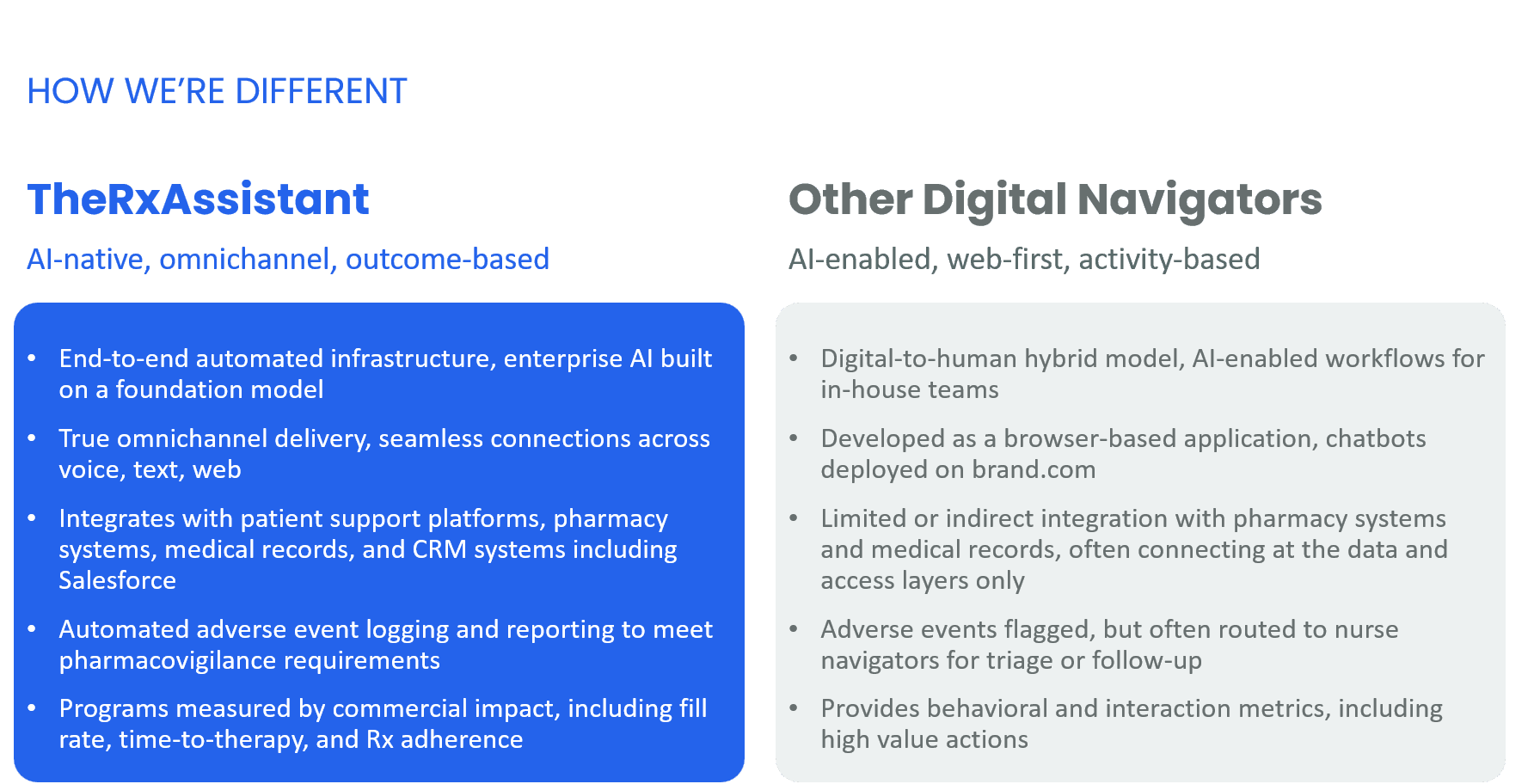
End-to-end automated infrastructure can scale patient support without sacrificing effectiveness
At TheRxAssistant, our approach is based on the belief that end-to-end automation can create a better access model. Many patient support programs still operate as digital-to-human hybrids: a portal or form collects information, but a human team handles follow-up, reconciliation, routing, and status tracking. That model can help with complex cases, but it is not always the most scalable way to improve access. Prior authorization illustrates the burden: in a 2024 American Medical Association survey, physicians reported completing an average of 39 prior authorizations each week and spending about 13 hours weekly on the process. For HCPs and their office staff, that time competes with clinical care, patient education, and follow-up. When every benefits check, reminder, missing-field request, refill prompt, or pharmacy update depends on manual intervention, program capacity is constrained by staffing levels and operating hours. [10]
An AI-based concierge platform can automate workflows from enrollment through adherence support. It can intake patient and provider information, identify missing data, trigger benefits verification, route prior authorization tasks, monitor payer and pharmacy status, prompt the right stakeholder at the right time, and escalate exceptions when human judgment is needed. Instead of replacing support teams, automation helps them focus on cases that require empathy, expertise, or complex problem-solving.
Automated infrastructure can operate continuously, standardize execution, reduce avoidable delays, and capture structured data as work happens. It is also easier to scale. Adding another therapy, region, provider group, or patient cohort does not require rebuilding a call-center model from scratch. The same orchestration engine can support different workflows, eligibility rules, consent requirements, and communication preferences. With appropriate governance, monitoring, and quality controls, an automated model can be as effective as a digital-to-human hybrid for many access tasks—and often faster and more consistent.
True omnichannel delivery meets patients where they actually are
True omnichannel engagement is a prerequisite. Too many digital health experiences assume patients will log into a portal, visit a brand website, find a chatbot, and type through a support journey. That assumption is flawed. Patients are busy, worried, distracted, and often unsure whom to trust. A browser-based chatbot may be useful for general information, but it is rarely enough to guide a patient through a complex, time-sensitive access process.
AI concierge solutions are more powerful when they work across voice, text, and the web as a unified experience. A patient might receive a text reminder that a consent form is missing, respond by voice because typing is inconvenient, and later check status through a web page. A caregiver might prefer SMS updates, while an HCP might need secure web-based task management that fits into daily practice workflows. Rather than forcing every user into a single interface, the system should maintain context across channels so the conversation follows the patient instead of making the patient start over each time.
Omnichannel engagement also supports better timing. The best intervention is often the one delivered before the patient disengages: a reminder that the pharmacy needs confirmation, an explanation of next steps after prior authorization approval, a prompt to enroll in copay support, or a refill nudge before medication runs out. AI can personalize these interventions based on therapy requirements, patient preferences, past response patterns, and journey status. That matters because windows close quickly: one analysis citing IQVIA data indicated that 98 million new therapy prescriptions were abandoned in 2023, with abandonment rising sharply at higher out-of-pocket costs. When outreach is timely, relevant, and available in the channel the patient uses, engagement improves. [4]
Deep integration across hubs, physician systems, and pharmacies is essential
Integration is required. A concierge solution that sits outside the real workflow may open a door, but it will not solve many problems unless it connects to the systems where access decisions and fulfillment actions occur. Hub services are only one part of the journey. Physician practice management systems, electronic health records and e-prescribing workflows, payer tools, specialty pharmacy systems, dispensing status feeds, and manufacturer reporting platforms all contain pieces of the truth.
Deep integration matters because medication access is a chain of dependencies. An HCP cannot respond to a missing documentation request if the request never reaches the right staff member. A patient cannot schedule delivery if the pharmacy cannot confirm benefits or contact information. A manufacturer cannot understand abandonment risk if hub, HCP, and pharmacy data remain disconnected. AI navigation becomes most effective when it can see the journey end to end and act on that visibility.
For HCPs and office teams, integration can reduce administrative burden by surfacing access tasks in familiar workflows and eliminating duplicate data entry. It can also help HCPs reinforce therapy initiation and adherence conversations because they have clearer visibility into the patient journey. For pharmacies, it can accelerate fulfillment by sending clean, actionable information and resolving outreach gaps quickly. For hubs, it can improve case management with real-time status and exception visibility. For manufacturers, it can provide compliant, aggregated insight into where patients get stuck and which interventions improve speed-to-therapy and persistence.
Without integration, AI risks becoming another disconnected tool layered on top of a fragmented ecosystem. With integration, it becomes an orchestration layer: not merely answering questions but coordinating work across the stakeholders responsible for helping the patient start and stay on therapy.
Automated adverse event logging strengthens pharmacovigilance
In a regulated environment, reducing friction cannot come at the expense of safety or accountability. Patient support interactions can surface information that may indicate an adverse event, product complaint, medication error, or other reportable safety concern. Manufacturers operate under strict requirements for identifying, documenting, and reporting such information; for example, FDA expedited safety reporting rules for human drug and biological products require serious and unexpected suspected adverse reactions to be reported as soon as possible and no later than 15 calendar days after the sponsor determines the information qualifies for reporting. As patient engagement expands across digital channels, manufacturers need confidence that safety signals will not be missed because they appeared in a text message, voice exchange, or web interaction. [11]
AI-based concierge platforms can help by detecting potential adverse event language, prompting for required minimum information, logging the interaction, routing it to the appropriate safety team, and maintaining an auditable record. When appropriate, the platform can direct patients back to their HCP for clinical questions, symptom assessment, or care decisions while ensuring potential reportable events are captured through the manufacturer’s safety process. Automation can standardize intake, reduce dependence on manual recognition, support timely escalation, and distinguish routine support questions from potential reportable events.
This capability is both a compliance and trust feature. Patients need to know that when they raise a concern, it will be captured and acted upon appropriately. Manufacturers need scalable engagement models that do not create unmanaged safety risk. Providers and pharmacies need confidence that patient support programs are designed with industry requirements in mind. Automated adverse event logging and reporting can make AI navigation safer, more accountable, and more acceptable in regulated environments.
From support program to intelligent access infrastructure
The larger shift is from patient support as a set of services to patient access as intelligent infrastructure. A modern AI concierge should not be measured only by how many chats it handles or how many calls it deflects. It should be measured by whether it helps patients move through their journey faster, with fewer abandoned prescriptions, fewer preventable delays, better adherence, and clearer communication among all stakeholders.
That requires thoughtful design. Automation must be transparent, compliant, and monitored. AI models must be validated for the workflows they support. Escalation pathways must be clear. Human support should remain available for complex, sensitive, or high-risk situations. Consent, privacy, security, and auditability must be built in from the beginning. The most effective model is not “AI instead of people” or “people instead of AI.” It is AI doing what automation does best—speed, scale, consistency, routing, reminders, pattern recognition, and documentation—while humans focus where judgment and relationships matter most.
For pharmaceutical manufacturers, the business case is compelling. Better access infrastructure can improve program performance, support faster therapy starts, reduce operational waste, generate actionable insights, and strengthen compliance controls. For HCPs, providers, and pharmacies, it can reduce administrative friction, improve access visibility, and make coordination easier. For patients, it can turn a confusing maze into a guided path. For the healthcare system, it can help prescribed therapies translate into real-world benefit.
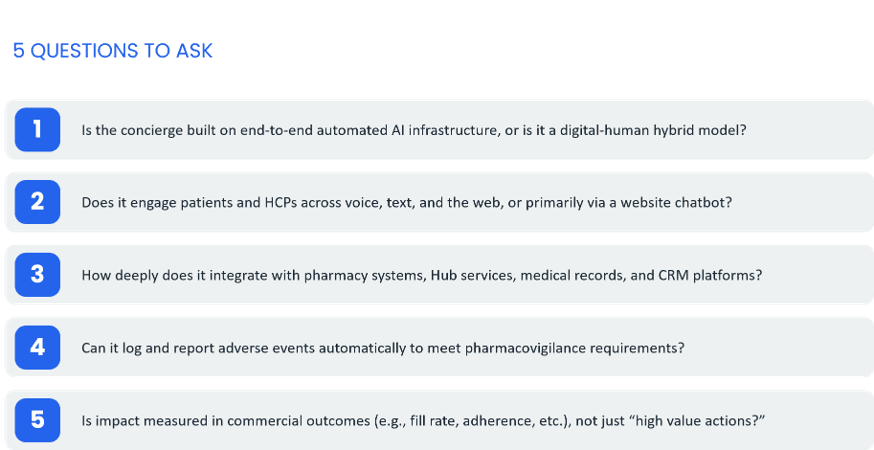
Less friction, better access, better outcomes
The promise of AI in prescription access is not novelty. It is execution. Patients do not need another website, phone number, or portal password. They need timely help that understands where they are in the journey, what is blocking progress, who needs to act next, and how to move the process forward.
AI-based concierge and navigation solutions can provide that help when they are built as end-to-end, omnichannel, deeply integrated, pharmacovigilance-ready infrastructure. By removing friction from provider search, scheduling, benefits verification, prior authorization, enrollment, financial support, pharmacy coordination, refill management, and safety reporting, these systems can help patients move from seeking care to starting treatment to staying on therapy. In doing so, they can help close the gap between clinical intent and real-world outcomes.
Sources
[1] CDC National Center for Health Statistics, “Sociodemographic Differences in Nonfinancial Access Barriers to Health Care Among Adults: United States, 2022,” National Health Statistics Reports No. 207, August 2024.
[2] Notable, “Notable Survey: 61% of Patients Skip Medical Appointments Due to Scheduling Hassles,” November 2022.
[3] ISPOR, “A Survey of Prescription Abandonment and Primary Medication Nonadherence Rates: A Literature Review,” Value in Health, 2023.
[4] Pleio, “Prescription Abandonment Statistics: The Overlooked Human and Financial Cost,” citing IQVIA 2024 prescription abandonment data.
[5] RazorMetrics, “2025 State of Drug Access,” April 2025.
[6] Fierce Pharma, “Too many patients aren’t filling their prescriptions. Here’s how the industry can change that,” sponsored by Phreesia, April 2024.
[7] Frontiers in Pharmacology, “Medication nonadherence—definition, measurement, prevalence, and causes: reflecting on the past 20 years and looking forwards,” March 2025.
[8] CDC National Center for Health Statistics, “Characteristics of Adults Aged 18–64 Who Did Not Take Medication as Prescribed to Reduce Costs: United States, 2021,” NCHS Data Brief No. 470, June 2023.
[9] CDC Preventing Chronic Disease, “Cost-Related Nonadherence and Mortality in Patients With Chronic Disease: A Multiyear Investigation, National Health Interview Survey, 2000–2014,” December 2020.
[10] American Medical Association, “AMA survey: Prior authorization reform pledge falls short with physicians,” May 2026.
[11] FDA, “Expedited Safety Reporting Requirements for Human Drug and Biological Products,” 21 CFR Parts 20, 310, 312, 314, and 600.